
 0 Likes
 0
Views
0
Views
 Written by - Vivek
 Introduction
Since its launch in January 2024, Pharmacy First has reshaped how patients access treatment for common conditions in England. Two years on, the scheme has moved well past its pilot phase and into a well-established part of primary care, with millions of consultations completed and independent prescribing due to expand its scope from autumn 2026. For community pharmacies, understanding exactly how the service works isn’t just useful background; it’s central to day-to-day operations, patient trust, and revenue.
1.What is Pharmacy First?
Pharmacy First is an NHS-funded advanced service that allows accredited community pharmacists to assess, diagnose, and treat patients for seven specific conditions without requiring a GP appointment. It was introduced as part of a wider £645 million investment aimed at freeing up general practice capacity and giving patients faster access to care for minor illnesses.
Before the scheme existed, a patient with earache or a suspected UTI would typically need to book a GP appointment, often days away, just to be prescribed something a pharmacist was already qualified to recommend. Pharmacy First closes that gap.
2. Which seven conditions does Pharmacy First cover?
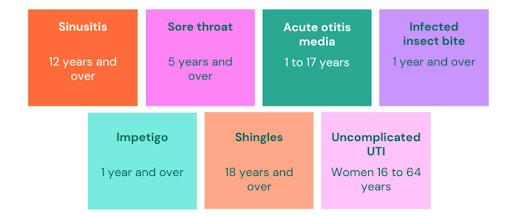
Pharmacists can manage the following conditions under defined clinical pathways, each with its own age restrictions:
-
Sinusitis, for patients aged 12 and over
-
Sore throat, for patients aged 5 and over
-
Earache, for children and young people aged 1 to 17
-
Infected insect bites, for patients aged 1 and over
-
Impetigo, for patients aged 1 and over
-
Shingles, for adults
-
Uncomplicated urinary tract infections in women aged 16 to 64
For shingles specifically, timing matters. Antivirals are most effective when started within 72 hours of the rash appearing, which makes same-day pharmacy access genuinely more clinically useful than waiting for a GP slot.
Consultations for these seven clinical pathways can be provided to patients presenting to the pharmacy as well as those referred electronically by NHS 111, general practices and others.
The service also incorporates the elements of the former Community Pharmacist Consultation Service: minor illness consultations with a pharmacist and the supply of urgent medicines (and appliances), both following an electronic referral from NHS 111, general practices (urgent supply referrals are not allowed from general practices) and other authorised healthcare providers (i.e. patients are not able to present to the pharmacy without an electronic referral).
In the clinical pathway consultations, people with symptoms suggestive of the seven conditions will be provided with advice and will be supplied, where clinically necessary, with a prescription-only treatment under a Patient Group Direction (PGD) or, in one pathway, an over-the-counter medicine (supplied under a clinical protocol), all at NHS expense.
From the autumn of 2026, pharmacist independent prescribers will be able to use their skills to complete episodes of care within the service, without the need for a PGD. However, for the time being, all pharmacists providing the service must use the PGDs and clinical protocol.
3.How does a Pharmacy First consultation actually work?
Patients can access the service in two ways: by walking into or contacting a participating pharmacy directly for one of the seven common conditions, or via a referral from a GP practice, NHS 111, or an urgent care setting.
During the consultation, the pharmacist takes a private, confidential history, covering symptoms, allergies, current medication, and relevant medical background. They don’t run diagnostic tests such as swabs or urine samples; instead, they rely on clinical assessment, sometimes using tools like an otoscope for ear complaints. Based on that assessment, the pharmacist can supply a prescription-only medicine under a patient group direction, recommend self-care, or refer the patient onward to a GP or emergency service if the presentation looks more serious.
Consultations are free at the point of use, though standard prescription charges still apply for the medicines themselves, and existing exemptions carry over as normal.
4.What’s changing in 2026?
From autumn 2026, the scheme is being extended so that pharmacist independent prescribers can complete episodes of care without requiring a patient group direction, giving pharmacies greater clinical flexibility as this qualification becomes more widespread across the workforce. Alongside this, a later claim window is being introduced for service fees, giving pharmacy owners a full three months to submit claims rather than the current shorter period.
These changes matter operationally. As eligibility and prescribing routes expand, pharmacies that have built strong internal processes around Pharmacy First and clearly communicated them to patients will be better positioned to absorb the extra volume without straining staff capacity.
5.Why does Pharmacy First matter for community pharmacies
Beyond the clinical value to patients, Pharmacy First has become a meaningful part of pharmacy income and footfall. Monthly payments are tied to consultation volume, and pharmacies are increasingly using the scheme as a way to build repeat patient relationships that extend into other services, from blood pressure checks to contraception consultations.
The pharmacies getting the most out of the scheme tend to be the ones that make it visible and easy to find, both in-store and online, so patients know they don’t need a GP appointment for these conditions. This is where the operational and digital side of running a pharmacy starts to matter as much as the clinical side. Getting the messaging right, tracking consultation caps, and making sure the service is easy for local patients to discover all feed into how much value a pharmacy actually captures from the scheme. This is exactly the kind of gap PharmaEscalator works with independent pharmacies to close, helping them translate NHS service uptake into sustainable local growth.
6.Where can patients find a participating pharmacy?
More than 10,000 pharmacies across the UK, over 90% of the total, are signed up to deliver Pharmacy First; patients can check participation using the NHS pharmacy finder or by contacting their local branch directly. Distance-selling pharmacies are the one notable exception for the otitis media pathway since that assessment requires an in-person otoscope examination.
7.Final thoughts
Pharmacy First has moved from a promising pilot to an embedded part of how patients in England access care for common conditions. With independent prescribing set to expand the service further from autumn 2026, the scheme’s role in community pharmacy is only going to grow. For pharmacies looking to make the most of that shift, whether that’s improving patient awareness, streamlining claims, or building a stronger local digital presence, PharmaEscalator can help turn service delivery into measurable growth.
Frequently Asked Questions
Is Pharmacy First free for patients?
Yes, the consultation itself is free. However, standard NHS prescription charges still apply to any medicine supplied, and existing exemptions (such as for children, pregnant women, or those on low incomes) continue to apply as normal.
Do I need a GP referral to use Pharmacy First?
No. For the seven common conditions, patients can walk into or contact a participating pharmacy directly without a referral. Referrals from GP practices, NHS 111, or urgent care settings are also accepted but aren’t required for these pathways.
Can a pharmacist prescribe antibiotics under Pharmacy First?
Yes, where clinically appropriate. Pharmacists can supply prescription-only medicines, including antibiotics and antivirals, under a Patient Group Direction, following NICE-aligned clinical pathways designed to support responsible antimicrobial use.
What happens if my condition needs more than a pharmacist can offer?
If the pharmacist believes your symptoms suggest something more serious, or fall outside the defined clinical pathway, they’ll refer you to a GP surgery or urgent and emergency care service rather than treating you themselves.
Will Pharmacy First cover more conditions in the future?
The scheme currently covers seven conditions, but NHS England has indicated it hopes to expand the list over time. From autumn 2026, independent prescribers will also be able to complete episodes of care without a Patient Group Direction, broadening how the service can be delivered.