
 0 Likes
 0
Views
0
Views
 Written by - Vivek
 Why Repeat Prescription Management Is a Growing
Repeat prescriptions account for a substantial share of daily workload in most community pharmacies, and that share keeps growing. Between checking requests against patient records, liaising with GP practices, managing stock for recurring items, and handling collection or delivery, the process eats into hours that could otherwise go towards clinical services or patient-facing care. As patient numbers grow and NHS services like Pharmacy First expand pharmacy responsibilities further, many independents are asking the same question: how do we manage this more efficiently without simply hiring more people?
The pressure isn’t limited to dispensing volume either. Staff are also expected to handle more complex conversations with patients, more clinical checks under expanded scopes of practice, and more administrative reporting than they were even a few years ago. Repeat prescription admin, if left unaddressed, quietly absorbs the hours that should be going towards these higher-value tasks. It’s rarely one single bottleneck causing the strain; it’s the accumulation of small manual steps repeated dozens of times a day across hundreds of patients.
For many independents, the instinct when workload increases is to bring in another pair of hands. But recruitment is slow, costly, and, in the current climate, often difficult to justify against tightening margins. The answer lies less in adding staff and more in removing friction from the process itself, so the same team can handle a growing repeat prescription volume without the workload becoming unsustainable.
2.What Does “Digitising” Repeat Prescriptions Actually Mean?
Digitising repeat prescription management doesn’t mean replacing staff with software, and it doesn’t require a large technology budget or an in-house IT team. It means using existing digital infrastructure, patient-facing apps, and automation to reduce the number of manual touchpoints a prescription needs before it reaches the patient. This includes electronic repeat dispensing, patient self-service ordering, automated reminder systems, and better integration between the pharmacy’s PMR system and NHS digital services.
Done properly, digitisation shifts repetitive admin away from staff time and towards systems that run in the background, freeing the team to focus on clinical checks, patient queries, and higher-value services. It also changes the nature of the work staff are doing day to day. Instead of spending time on data entry, chasing paperwork, or fielding routine phone calls, pharmacy teams can spend more of their time on the interactions that genuinely require a trained professional, which tends to improve both staff satisfaction and patient experience.
It’s worth being clear-eyed about what digitisation won’t solve. It won’t fix a fundamentally disorganised workflow, and it won’t compensate for a pharmacy that hasn’t reviewed how repeat requests move through the building in the first place. The tools are only as effective as the process they’re layered on top of.

3. Electronic Repeat Dispensing (eRD): The Foundation
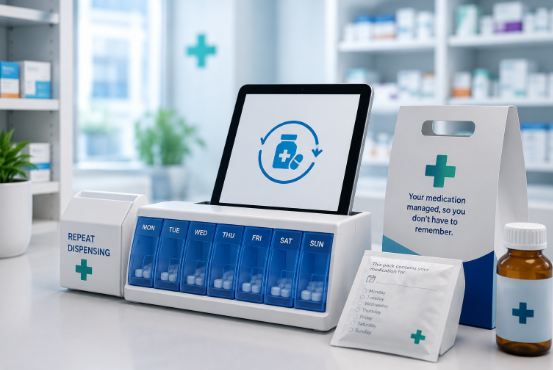
Electronic Repeat Dispensing allows GPs to issue a batch of repeat prescriptions in one go, which are then released to the pharmacy at set intervals without the patient or practice needing to generate a new request each time. For pharmacies still managing paper-based repeat slips or chasing practices individually for reissues, eRD is often the single biggest efficiency gain available and usually the first place to focus digitization efforts.
Encouraging GP practices to enrol suitable patients in eRD and reviewing which patients on your own repeat list would benefit reduces the volume of one-off admin tasks considerably. Patients on long-term, stable medication for conditions like hypertension or hypothyroidism are typically strong candidates, since their dosages rarely change and the risk of clinical review being missed is low. It also improves medicines adherence, since patients receive a consistent, predictable supply rather than needing to remember to request each cycle.
The practical challenge for many independents isn’t understanding eRD, but getting GP practices to actively use it at scale. Building a working relationship with local practices, and proactively flagging suitable patients rather than waiting for the practice to identify them, tends to accelerate adoption. Some pharmacies have found it useful to keep a simple internal list of patients who would benefit from eRD but aren’t yet enrolled, and to raise this periodically with the relevant surgery rather than relying on it happening automatically.
4.Ordering Apps and Online Portals for Patients
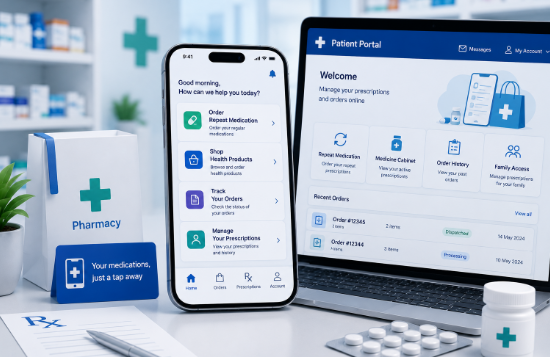
Patient-facing ordering apps and NHS App integration allow patients to request their own repeats without a phone call or a paper form dropped at the counter. This removes a significant volume of manual data entry and phone-based interruptions from staff schedules, particularly during the busiest parts of the day when phone queries can pull staff away from the dispensary.
For independents without the resources to build custom software, adopting existing NHS-compatible ordering tools and actively promoting them to patients is usually the fastest route to uptake. This can be done through in-store signage, text reminders, or simple conversations at the counter when a patient is already collecting a prescription. The barrier is rarely the technology itself but patient awareness and trust in using it. Older patients or those less comfortable with apps may need a short demonstration the first time, but many pharmacies find that once a patient successfully orders online once, they rarely go back to phoning in.
It’s also worth considering how the app or portal integrates with your existing PMR system. A tool that generates a request which still has to be manually re-entered into the dispensing system delivers only half the benefit. The real efficiency gain comes when the patient’s digital request flows directly into the pharmacy’s existing workflow without a staff member needing to transcribe it.
5.Automating Reminders and Renewal Requests
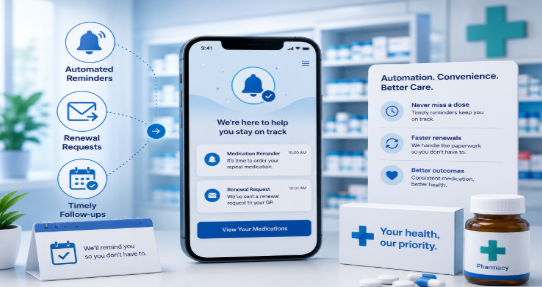
A large portion of repeat prescription admin isn’t the dispensing itself, but the back-and-forth around timing: chasing patients who haven’t ordered, managing early or late requests, and following up on missed collections. Automated SMS or app-based reminders, triggered a set number of days before a repeat is due, can handle this without staff intervention, and can significantly cut down on the volume of “Is my prescription ready” phone calls that interrupt dispensary work.
Well-designed reminder systems can also help reduce medicines waste. When patients are reminded only when a repeat is genuinely due, rather than pharmacies dispensing on a fixed schedule regardless of actual need, stock isn’t tied up in prescriptions that go uncollected. This is a smaller but meaningful benefit for pharmacies managing tight margins on high-volume repeat items.
This is also where compliant, well-timed messaging matters. Pharmacies need to ensure that reminder systems align with GDPR and NHS communication guidelines, particularly regarding consent and the wording of automated messages. Getting this wrong isn’t just a compliance risk; poorly worded or overly frequent messages can also cause patients to opt out of digital communication altogether, undoing the efficiency gain. This is somewhere many independents choose external support to get the technical and compliance groundwork right, which is one of the areas PharmaEscalator works with pharmacies on when setting up SMS and messaging systems that don’t inadvertently create compliance risk.
6.Integrating Systems Instead of Adding Headcount
The biggest inefficiency in most pharmacies isn’t a lack of tools, but a lack of integration between the tools they already have. A PMR system, an ordering app, and NHS digital services that don’t talk to each other still require a person to bridge the gaps manually, checking one system against another, re-entering the same information more than once, or reconciling discrepancies at the end of the day.
Reviewing whether your current systems can be connected, whether through existing NHS interoperability options or third-party integrations, is often more valuable than adding new software altogether. Pharmacies that assess this properly tend to find that the admin burden was never really about staffing levels, but about disconnected processes creating unnecessary duplicate work.
A useful exercise here is to map, step by step, everything that happens to a repeat prescription from the moment a request comes in to the moment it’s handed to the patient. Most pharmacies are surprised by how many manual handoffs exist in that chain, and how many of them could be eliminated simply by connecting systems that are already in place rather than purchasing something new.
7.Staff Time Reallocation: Where the Savings Actually Go
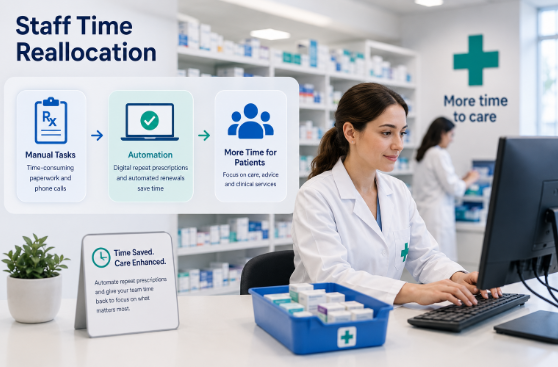
Digitising repeat prescription management only delivers value if the time saved is put to good use. Simply automating admin without a clear plan for redeployed staff time tends to produce marginal gains rather than meaningful ones. Pharmacies that see the biggest benefit are usually those that have thought in advance about where freed-up hours will go.
In practice, this often means more time available for services like Pharmacy First consultations, medicines use reviews, vaccination clinics, or simply more attentive counter interactions during busy periods. It can also mean redistributing dispensary staff more evenly across the day, rather than having everyone stretched thin during predictable peak times caused by repeat prescription bottlenecks.
It’s worth having an honest conversation with the team about this before implementing new digital tools. Staff are more likely to embrace new systems when they understand what the time savings are actually for, rather than feeling as though efficiency gains exist purely to increase throughput without any corresponding benefit to their day-to-day workload.
8.Common Pitfalls When Digitising Repeat Processes
A few recurring mistakes tend to undermine digitisation efforts in community pharmacy settings. The first is adopting new tools without retiring the old process alongside them. If patients can still phone in requests, drop off paper slips, and use a new app simultaneously, staff end up managing three parallel systems instead of one, which increases workload rather than reducing it.
The second is underestimating the importance of patient onboarding. A digital tool that patients don’t understand or trust will see low adoption, and low adoption means the manual workaround processes never actually disappear. Clear, repeated communication about how and why to use a new system matters as much as the system itself.
The third is treating digitisation as a one-off project rather than an ongoing process. Systems, NHS guidance, and patient expectations all shift over time, and workflows that were efficient a year ago may have quietly become bottlenecks again. Periodically revisiting the repeat prescription process, even briefly, helps catch this before it becomes a larger problem.
9.Measuring Whether Digitisation Is Working
Digitising repeat prescription management should produce measurable results: fewer phone calls at peak times, reduced time spent per prescription, fewer stock discrepancies from unpredictable ordering, and better patient satisfaction with collection times. Tracking these metrics before and after implementing changes helps pharmacies understand whether the digital tools are genuinely reducing workload or simply shifting it elsewhere.
Simple measures, such as logging how many repeat requests come in via phone versus app over a given month, or timing how long dispensary staff spend on repeat-related admin during a typical shift, can provide a clear before-and-after picture without requiring sophisticated reporting tools. Patient feedback, gathered informally at the counter or through short surveys, can also reveal friction points that internal metrics alone might miss.
For pharmacies unsure where to start, an audit of current repeat prescription workflows, looking specifically at where manual intervention happens most often, is usually the most useful first step before investing in new systems. Identifying the two or three biggest friction points and addressing those first tends to produce faster, more visible results than attempting to digitise everything at once.
Frequently Asked Questions
Does digitising repeat prescriptions mean replacing pharmacy staff?
No. Digitisation shifts repetitive admin, such as data entry and chasing paperwork, away from staff time and onto systems that run in the background. Staff time is redirected towards clinical checks, patient queries, and higher-value services like Pharmacy First consultations, not eliminated.
What’s the difference between eRD and a patient ordering app?
Electronic Repeat Dispensing (eRD) is a GP-side process that releases a pre-authorised batch of prescriptions at set intervals without a new request each cycle. Ordering apps and portals sit on the patient side, letting them request repeats without a phone call. The two work together rather than replacing each other.
Which patients are best suited to eRD?
Patients on long-term, stable medication, such as those for hypertension or hypothyroidism, tend to be strong candidates, since their dosages rarely change and the risk of a missed clinical review is low.
Will an ordering app actually reduce admin if it still needs manual re-entry into the PMR system?
No, this delivers only half the benefit. The real efficiency gain comes when a patient’s digital request flows directly into the pharmacy’s existing dispensing workflow without a staff member needing to transcribe it, which is why PMR integration matters as much as the ordering tool itself.
What compliance considerations apply to automated reminder messages?
Reminder systems need to align with GDPR and NHS communication guidelines, particularly around consent and message wording. Poorly worded or overly frequent messages can also cause patients to opt out of digital communication altogether, undoing the efficiency gain.
What’s the most common mistake pharmacies make when digitising repeat processes?
Adopting new tools without retiring the old ones. If patients can still phone in, drop off paper slips, and use a new app all at once, staff end up managing three parallel systems instead of one, increasing workload rather than reducing it.