
 0 Likes
 0
Views
 Written by - Vivek
Introduction
People now ask search engines and AI assistants questions they once saved for a pharmacist or GP. Can I take these two medicines together? What are the side effects of this antibiotic? Is this symptom serious? The answers appear in AI Overviews, chatbot responses and conversational search tools, often without the person clicking through to a website.
This changes what it takes for health and pharmacy content to be seen. When an AI system builds an answer, it has to decide which sources are reliable enough to draw from. That decision is where E-E-A-T comes in, and for medical topics the stakes are higher than anywhere else on the web.
This article explains what E-E-A-T is, why health and pharmacy content is held to a stricter standard, how AI search raises the importance of trust signals, and what pharmacy teams and content writers can do about it.
1. What Is E-E-A-T?
E-E-A-T stands for Experience, Expertise, Authoritativeness, and Trustworthiness. Google uses it in its Search Quality Rater Guidelines, which human evaluators follow when assessing search results. The extra E for Experience was added in December 2022 to recognise the value of first-hand knowledge.
Each element has a distinct meaning. Experience refers to first-hand or real-world involvement with the subject, such as a pharmacist who counsels patients every day. Expertise is the depth of knowledge and qualification behind the content. Authoritativeness is the reputation of the author, the organisation and the website within its field. Trustworthiness is the content’s overall reliability, including accuracy, transparency, and safety.
Google describes trust as the most important of the four, with the others supporting it. It is also worth noting that E-E-A-T is not a single ranking factor or a score. It is a way of describing the qualities that Google’s systems aim to reward, using many different signals.
2. Why Is Health and Pharmacy Content Treated Differently?
Google places health topics in a category it calls Your Money or Your Life, usually shortened to YMYL. These are subjects where poor information could affect a person’s health, safety, finances or wellbeing. Medical advice, medicine information, dosage guidance and condition explanations all fall into this group.
The reasoning is simple. A badly written article about holiday destinations is a minor inconvenience. A badly written article about medicine dosage can cause real harm. For this reason, quality standards for health content are higher, and the expectation that the author has genuine qualifications is stronger.
Pharmacy content sits in a particularly sensitive position. Readers treat pharmacy websites as extensions of the professional service. If a pharmacy publishes guidance on over-the-counter medicines, vaccinations or minor ailments, readers assume a regulated professional stands behind it. That assumption is what makes accuracy and clear authorship so important.
3.How Does AI Search Change the Picture?
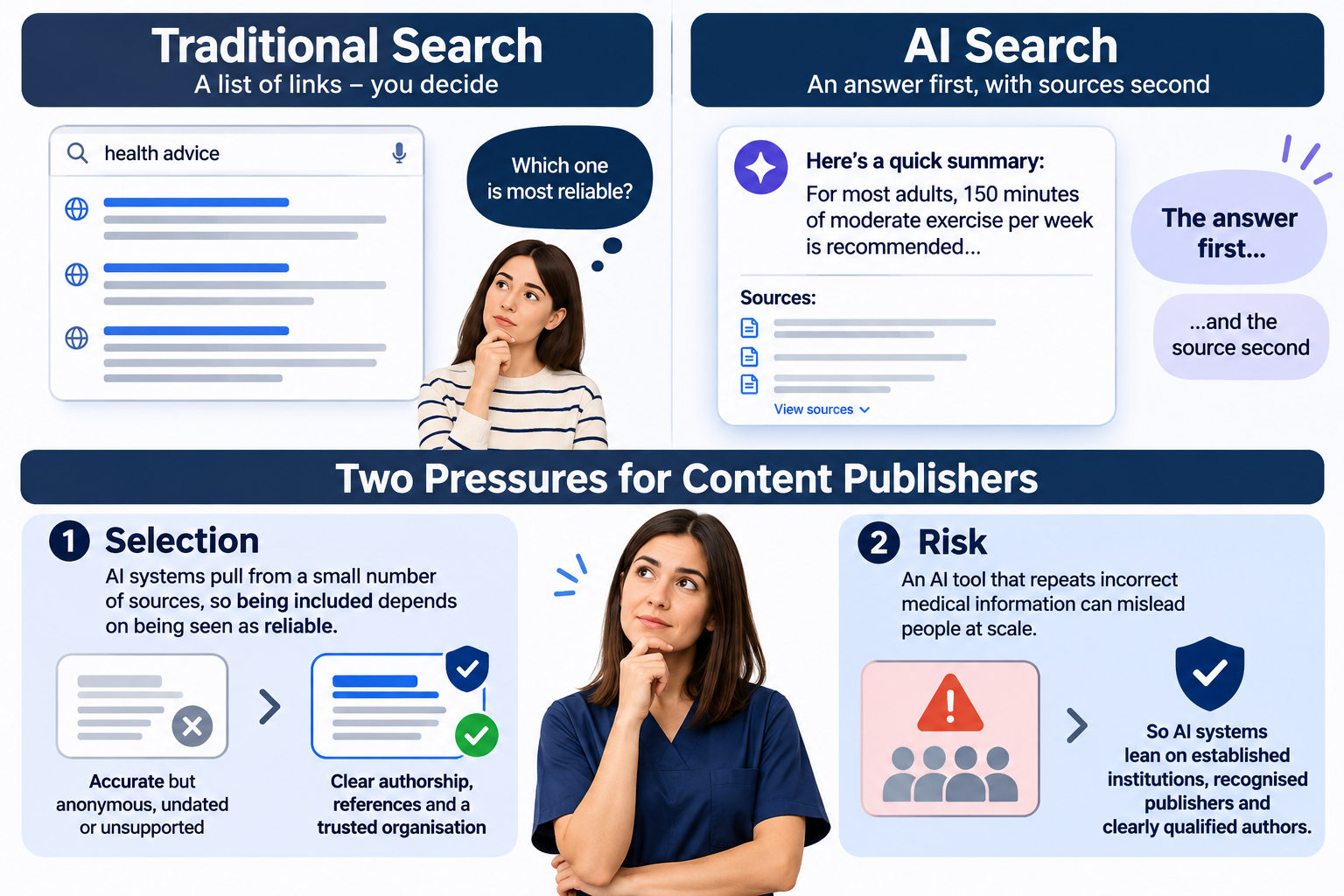
Traditional search shows a list of links and lets the reader judge. AI search does something different. It reads many sources, combines information and presents a single summary, often with a handful of cited sources. The reader sees the answer first and the source second, if at all.
This creates two pressures on content publishers.
The first is selection. AI systems pull from a small number of sources, so being included depends on being seen as reliable. A page that is accurate but anonymous, undated or unsupported by evidence is easier to pass over than one with clear authorship, references and a visible organisation behind it.
The second is risk. An AI tool that repeats incorrect medical information can mislead people at scale, and the companies building these tools know it. As a result, systems tend to be cautious about health topics, leaning on established institutions, recognised publishers and clearly qualified authors.
4. Why Does E-E-A-T Matter More in AI Search?
Several reasons explain why trust signals carry extra weight in this environment.
AI answers compress sources into one response. In a standard results page, a user can compare ten links and apply their own judgement. In an AI summary, that comparison happens inside the system. Trust signals help the system decide which sources deserve to be included in the first place.
Errors are harder to spot. When a reader sees a claim inside a confident, well-written summary, they are less likely to question it. This raises the cost of a mistake and the pressure on AI systems to rely on dependable material.
Authorship and entity recognition matter more. AI and search systems increasingly try to understand who is behind content and how that person or organisation is connected to a topic. A named pharmacist with a verifiable registration, a professional profile and a consistent publishing record is a stronger signal than an unnamed author.
Consistency across the web counts. If a pharmacy is described the same way on its own website, its professional listings and its social profiles, systems can connect those mentions and build a clearer picture of the business. Contradictory or thin information makes that harder.
Accuracy and freshness affect trust. Medical guidance changes. Safety alerts are issued, licences are updated and clinical guidelines are revised. Content that is out of date can be inaccurate, which damages trust directly.

5. How Can Pharmacy Content Show Experience?
Experience is the newest element and often the easiest to overlook. For pharmacy content, it means showing that the writer or reviewer has real contact with the subject.
Practical ways to do this include drawing on common questions patients ask at the counter, describing what a consultation typically involves, and explaining how a service such as a vaccination clinic or medicine review works from the pharmacy’s perspective. Original photographs of the premises and team, where appropriate, also help demonstrate that the service is real.
The aim is not to add personal stories for their own sake. It is to make sure the content reflects how things actually work, not a generic summary of information available everywhere.
6. How Can Content Demonstrate Expertise?
Expertise is shown through qualifications, accuracy and depth. For health and pharmacy content, the most effective step is having content written or reviewed by a suitably qualified professional and saying so clearly on the page.
A strong author or reviewer note usually includes the person’s name, professional role, registration body and registration number where relevant, such as the General Pharmaceutical Council for UK pharmacists. It should link to a short biography page that explains their background.
Depth matters as well. Content that explains why a recommendation exists, not only what it is, signals a stronger grasp of the subject. For example, a page on antibiotics should explain why courses should be completed as directed and why they are not suitable for viral infections, rather than listing instructions without context.
7. How Can a Pharmacy Build Authoritativeness?
Authoritativeness grows over time and comes largely from how others treat the source. Being referenced by reputable organisations, professional bodies, local health partners and trade publications all contribute.
Pharmacies and pharmacy technology providers can build it by publishing consistent, high-quality material on a defined set of topics instead of covering everything. A site that focuses on community pharmacy services, medicines information and patient guidance builds a clearer identity than one that publishes on unrelated subjects.
It also helps to keep professional profiles accurate and consistent, contribute to local or industry discussions, and link to authoritative sources such as the NHS, the MHRA and NICE when supporting claims. Outbound references to reliable institutions show that the content sits within the established body of knowledge and is not isolated from it.
8. How Can Content Prove Trustworthiness?
Trust is the foundation, and it is built through many small, visible choices.
Accuracy comes first. Every medical claim should be checked against a current authoritative source, and where a source exists, it should be cited. Dates matter, so pages should show when they were published and last reviewed.
Transparency follows. Readers should be able to see who runs the website, where the pharmacy is based, how to contact it and what its regulatory status is. Clear About, Contact, and Editorial Policy pages support this.
Safety language is also part of trust. Health content should make clear when a reader needs to speak to a pharmacist, GP or emergency service, and it should avoid making promises about outcomes or presenting general information as personal medical advice.
Site security and privacy are the final layer. A secure connection, a clear privacy policy and careful handling of any patient data or enquiry forms all contribute to a trustworthy experience

9. Which Mistakes Weaken E-E-A-T in Health Content?
Several common problems undermine trust signals.
Anonymous content with no named author or reviewer is one of the most frequent. Another is publishing medical information that has not been checked against current guidance. Overly promotional wording, such as exaggerated claims about treatments or services, also works against trust, because it shifts the tone from informing to selling.
Thin pages that repeat widely available information without any added insight give systems little reason to select them. Outdated pages that still show old pricing, withdrawn guidance or retired products can harm credibility. Finally, unsupported claims, where statistics or health statements are given without a source, make it harder for both readers and AI systems to rely on the page.
10. How Can You Tell Whether E-E-A-T Is Improving?
There is no single E-E-A-T score to check, but several indicators help. Look at whether pages are being cited or referenced in AI answers for relevant queries, whether branded searches are growing, and whether other reputable sites link to the content. Engagement measures such as time on page and returning visitors also point to whether readers find the content useful.
A regular content audit is the most practical habit. Reviewing each health page for accuracy, authorship, references and freshness every six to twelve months keeps the content aligned with current guidance and shows a visible commitment to quality.
11. Conclusion
AI search has not changed the basic rule that health information should come from people who know what they are talking about. It has made that rule more visible and more consequential. When an AI system selects only a few sources to build an answer, those sources need to demonstrate real experience, verified expertise, recognised authority and clear trustworthiness.
For pharmacies and pharmacy technology providers, the opportunity is practical. Name the qualified professionals behind the content, support claims with authoritative sources, keep pages current, and write in an informational tone that puts the reader’s understanding ahead of promotion. Doing this consistently builds the kind of reputation that both patients and AI systems can rely on.
Frequently Asked Questions
What does E-E-A-T stand for in SEO?
E-E-A-T stands for Experience, Expertise, Authoritativeness and Trustworthiness. It is a framework used in Google’s Search Quality Rater Guidelines to describe the qualities of reliable content. It is not a single ranking factor or score, but a way of describing what Google’s systems aim to reward.
Why is E-E-A-T more important for health and pharmacy content?
Health and pharmacy topics fall under Your Money or Your Life (YMYL) content, where inaccurate information can affect a person’s health or safety. Readers also assume a regulated professional stands behind pharmacy guidance, so accuracy, qualified authorship and clear sourcing are held to a higher standard.
How does AI search change the importance of E-E-A-T?
AI search tools combine information from several sources into one summary and cite only a few of them. Because errors inside a confident summary are harder for readers to spot, AI systems tend to rely on sources that show clear authorship, verified expertise and trustworthy references, especially for medical topics.
How can pharmacy websites demonstrate E-E-A-T?
Pharmacy websites can name the pharmacist who wrote or reviewed each page, including their role and registration details, and link to a short biography. They should also cite authoritative sources such as the NHS, MHRA and NICE, show published and last reviewed dates, and provide clear contact, about and editorial policy pages.
What mistakes weaken E-E-A-T in health content?
Common mistakes include anonymous authorship, medical information that has not been checked against current guidance, overly promotional wording, thin pages that repeat widely available information, outdated content and statistics or health claims given without a source.